Last updated: May 2026
Exfoliated Vermiculite Technical Specifications, Grades & B2B Bulk Supply
Technical data compiled and verified by the materials engineering team at Dosar Ceramics, Katni, India.
Exfoliated vermiculite is a chemically inert, sterile hydrous phyllosilicate mineral represented by the chemical formula (Mg, Fe++, Al)3(Al, Si)4O10(OH)2.4(H2O). Sourced from certified asbestos-free deposits, the raw ore undergoes rapid thermal exfoliation to expand 8–14 times its original volume, yielding lightweight, non-combustible granules with low thermal conductivity (0.063–0.0819 W/mK) and a neutral pH of 6.5–7.8. Dosar Ceramics manufactures and exports custom-graded, high-purity expanded vermiculite (0–5mm) engineered for passive fireproofing, building insulation, and agricultural substrates, exported directly from our manufacturing facility in Katni, India to global B2B markets.
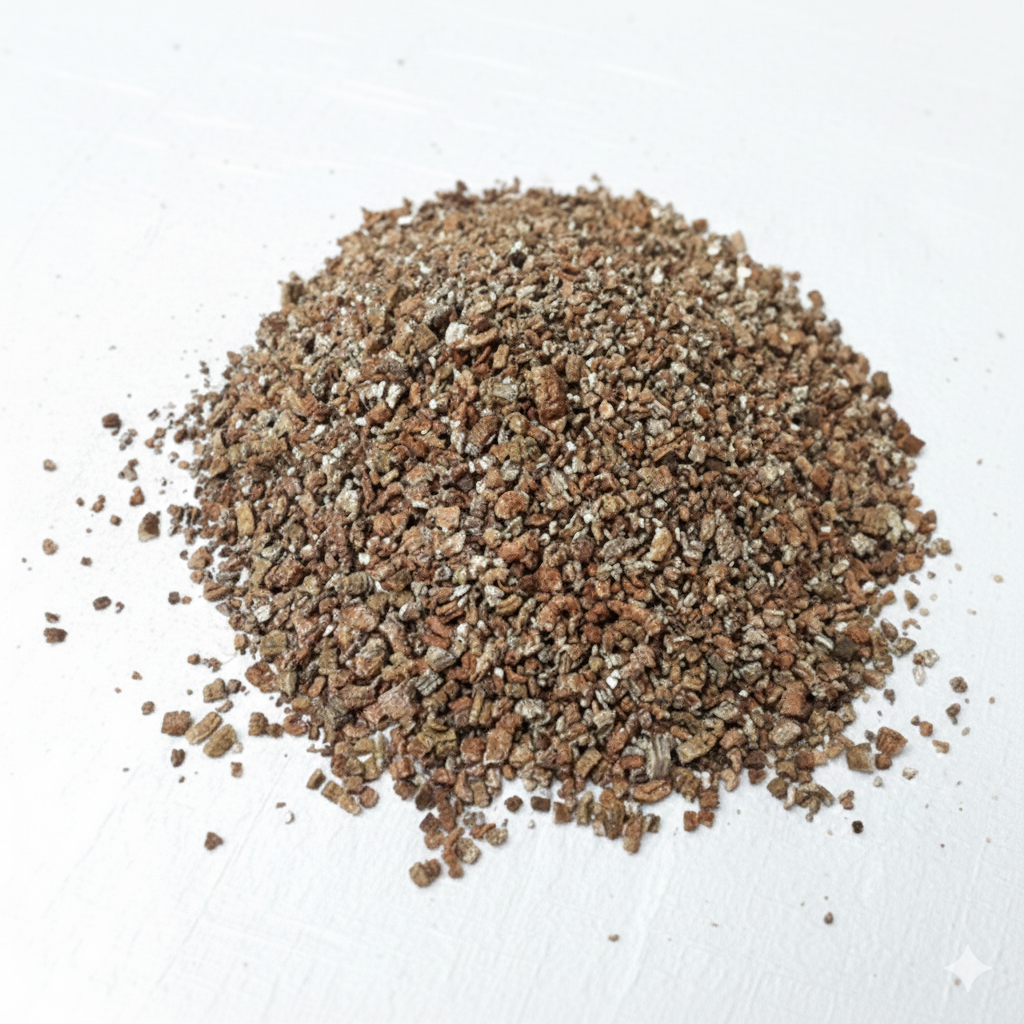
Grading & Applications Matrix (0–5mm Precision)
We process and grade exfoliated vermiculite in specific grain size distributions. Select the optimal grade matching your industrial, agricultural, or refractory requirements.
| Grade | Size Range | Primary Industrial & Agricultural Applications |
|---|---|---|
| Large | 2.0 - 4.0 mm | Hydroponic growing media, coarse soil aeration, and lightweight concrete aggregates. |
| Medium | 1.0 - 3.0 mm | Commercial potting soils, vertical farming substrates, and fire-resistant board cores. |
| Fine | 0.5 - 2.0 mm | Horticultural seed starting, root propagation, and nutrient carriers for animal feed. |
| Superfine | 0.25 - 1.7 mm | Precision germination plugs, automotive friction linings, and passive fireproof sprays. |
| Unexpanded Raw | Variable | Crude feedstock for exfoliation plants and functional fillers for industrial sealants. |
Industrial Performance & Global Applications
Our exfoliated vermiculite is engineered to perform reliably under extreme temperatures and challenging climatic conditions worldwide.
Industrial Refractory & Fireproofing Suitability
Our exfoliated vermiculite provides excellent passive fire protection due to its high classification temperature of 1150°C. It is an ideal lightweight aggregate for formulating fire-rated doors, plasters, and thermal insulation screeds designed to align with international safety parameters, including the UAE Fire and Life Safety Code of Practice. Material meets the classification requirements applicable under IS 3116 (Indian Standard for thermal insulation products) and is suitable for formulations targeting compliance with ASTM E136 non-combustibility testing.
Horticultural and Soilless Agriculture for Arid Climates
Its high water-absorption capacity (retaining 3 to 4 times its dry weight) and high cation exchange capacity (60–100+ meq/100g) make it a highly sought-after soil conditioner for GCC agricultural projects, assisting in water conservation in arid soils.
Why Source from Dosar Ceramics
We are a direct manufacturer — not a trader — operating our own exfoliation plant in Katni, Madhya Pradesh, India's principal vermiculite processing region.
In-House Exfoliation Plant
Every batch is processed at our own facility, giving buyers direct traceability from raw ore to finished grade. No middlemen, consistent quality control, and competitive ex-works pricing.
FCL Export from Nhava Sheva
We handle full container load (FCL) export logistics, customs documentation, HS Code classification (6806.20 / 2530.10), and coordinate directly with freight forwarders for GCC, European, and Southeast Asian buyers.
Exfoliated Vermiculite vs. Expanded Perlite
Understand the key mechanical, chemical, and physical differences between exfoliated vermiculite and expanded perlite to optimize raw material procurement for your project.
| Property / Feature | Exfoliated Vermiculite | Expanded Perlite |
|---|---|---|
| Water Retention | High (retains 300% to 400% of dry weight) | Low (primarily surface-holding only) |
| Cation Exchange Capacity | High (60 to 100+ meq/100g) | Very low (minimal nutrient retention) |
| Primary B2B Uses | Moisture-loving crops, passive fire sprays, light plaster | Cryogenic insulation, high-drainage mixes, filtration aids |
Frequently Asked Questions About Exfoliated Vermiculite
Explore technical answers regarding material properties, chemical composition, safety compliance, and commercial procurement of our vermiculite products.
What is exfoliated vermiculite?
Exfoliated vermiculite is natural vermiculite ore that has been heated to high temperatures (typically 800–1000 °C), causing the layered flakes to expand into lightweight, worm‑like granules with many air pockets inside.
How does exfoliation work?
When heated, water trapped between the silicate layers of raw vermiculite flashes into steam, pushing the layers apart and increasing volume by roughly 8–14 times the original volume.
What is the typical expansion ratio?
Exfoliated vermiculite generally expands to about 8–14× its original volume, depending on ore quality, moisture content, particle size, and exfoliation temperature profile.
What is the chemical composition of exfoliated vermiculite?
Typical expanded product contains mainly silica (SiO₂ ~30%), iron oxide (Fe₂O₃ ~16%), aluminium oxide (Al₂O₃ ~14–15%), calcium oxide (CaO ~9–10%), and minor alkalis, with average moisture around 7–8% and loss on ignition near 11%.
Is exfoliated vermiculite chemically inert?
Yes; properly exfoliated vermiculite is generally chemically inert, stable in neutral to slightly alkaline environments, and resistant to most industrial chemicals and fertilizers, which makes it suitable for refractories, construction, and agriculture.
What is the bulk density range?
Exfoliated vermiculite has a very low bulk density, typically in the range of 150-170 kg/m³ for coarser grades and up to around 250–300 kg/m³ for fines or partially compacted products.
What are the main thermal‑insulation properties?
Because of its layered, air‑filled structure, exfoliated vermiculite is a poor conductor of heat, giving low thermal conductivity (good K‑factor for insulation) and making it useful in loose‑fill insulation, fire‑protection, and refractory mixes.
Is vermiculite a good fire‑resistant or fire‑proof material?
Exfoliated vermiculite is non‑combustible, stable at high temperatures, and widely used in fire‑protection boards, insulation coatings, and refractory castables to improve fire resistance and thermal shock resistance.
What particle sizes are available?
Common industrial grades span from fine powder or 0.5–1 mm (for coatings, agriculture, and fillers) up to 3–6 mm flakes (for loose‑fill insulation, floating concrete, and refractory aggregates).
Is exfoliated vermiculite safe for plants?
Yes. It is non-toxic, sterile, and improves soil aeration and moisture retention, making it ideal for seed germination and hydroponic systems.
How is exfoliated vermiculite used in agriculture?
In horticulture, it is used as a soilless growth medium or additive to improve aeration, moisture retention, and nutrient‑holding capacity, promoting seed germination, root development, and reduced leaching.
What are the construction and building applications?
Exfoliated vermiculite is used in lightweight concrete blocks, rendering plasters, fire‑proof boards, loose‑fill cavity insulation, and ceiling sprays because of its low density, fire resistance, and thermal‑insulation properties.
Is exfoliated vermiculite safe to handle?
Modern exfoliated vermiculite from certified sources is generally regarded as safe to handle; however, it is advisable to avoid inhalation of dust and use standard industrial hygiene practices (respirators, PPE) in large‑scale processing.
Can exfoliated vermiculite be mixed with binders?
Yes; it can be combined with inorganic binders such as sodium silicate, cement, or gypsum to form moulded insulation panels, fire‑proof boards, or refractory pre‑cast shapes.
What should buyers check in exfoliated vermiculite specifications?
Key specs to specify include: bulk density, moisture content, LOI, particle size distribution, pH, and fire‑resistance / application‑specific performance data (e.g., thermal conductivity, compressive strength in mixes).
What are the main uses of exfoliated vermiculite?
Exfoliated vermiculite is used in: Fireproofing and insulation, Lightweight concrete and plaster, Horticulture and hydroponics, Packaging and spill absorption.
What is the difference between vermiculite and perlite?
Vermiculite retains more water and nutrients, while perlite provides better drainage and aeration. Vermiculite is ideal for moisture retention, whereas perlite is better for preventing overwatering.